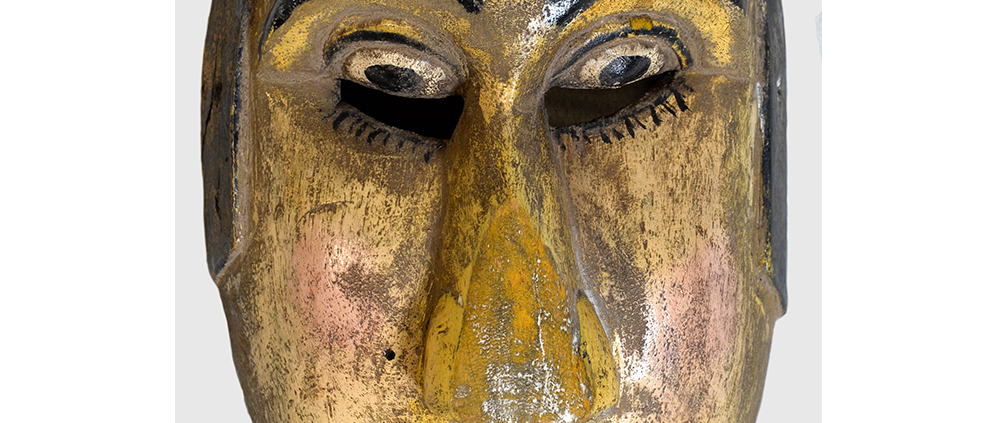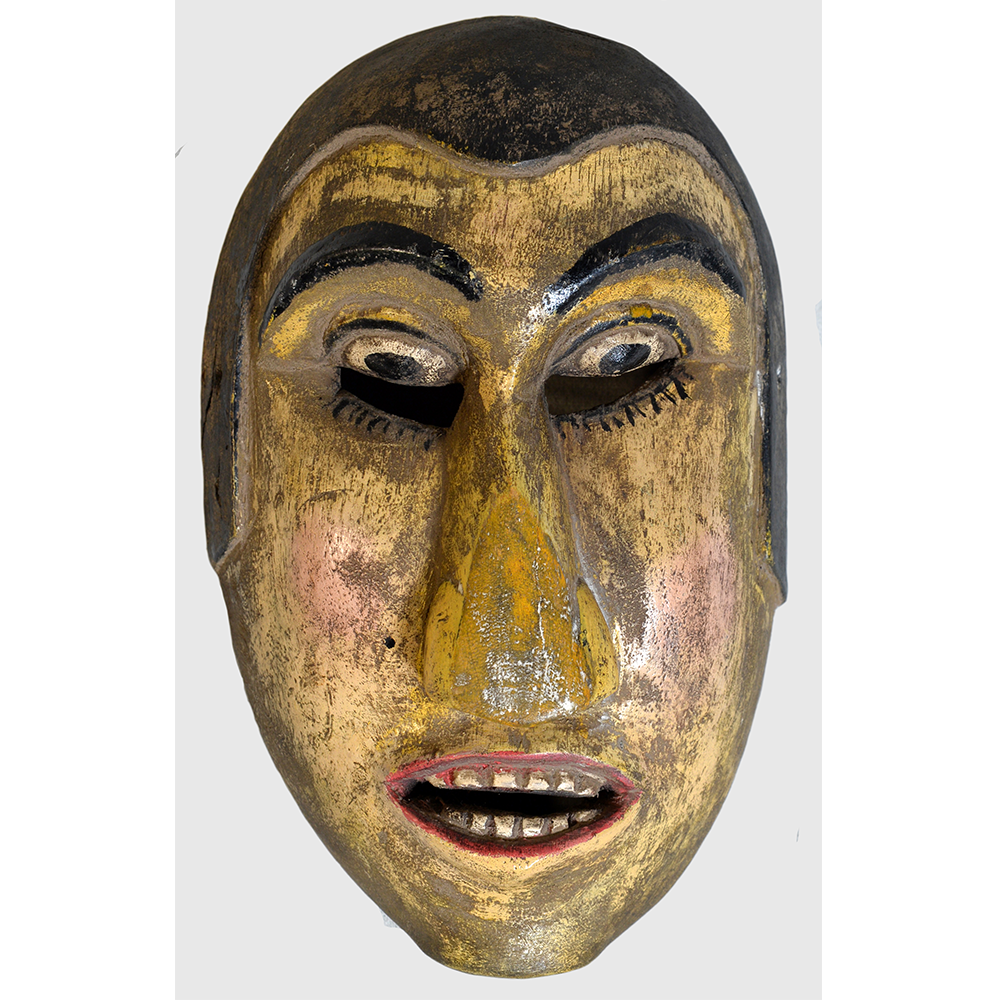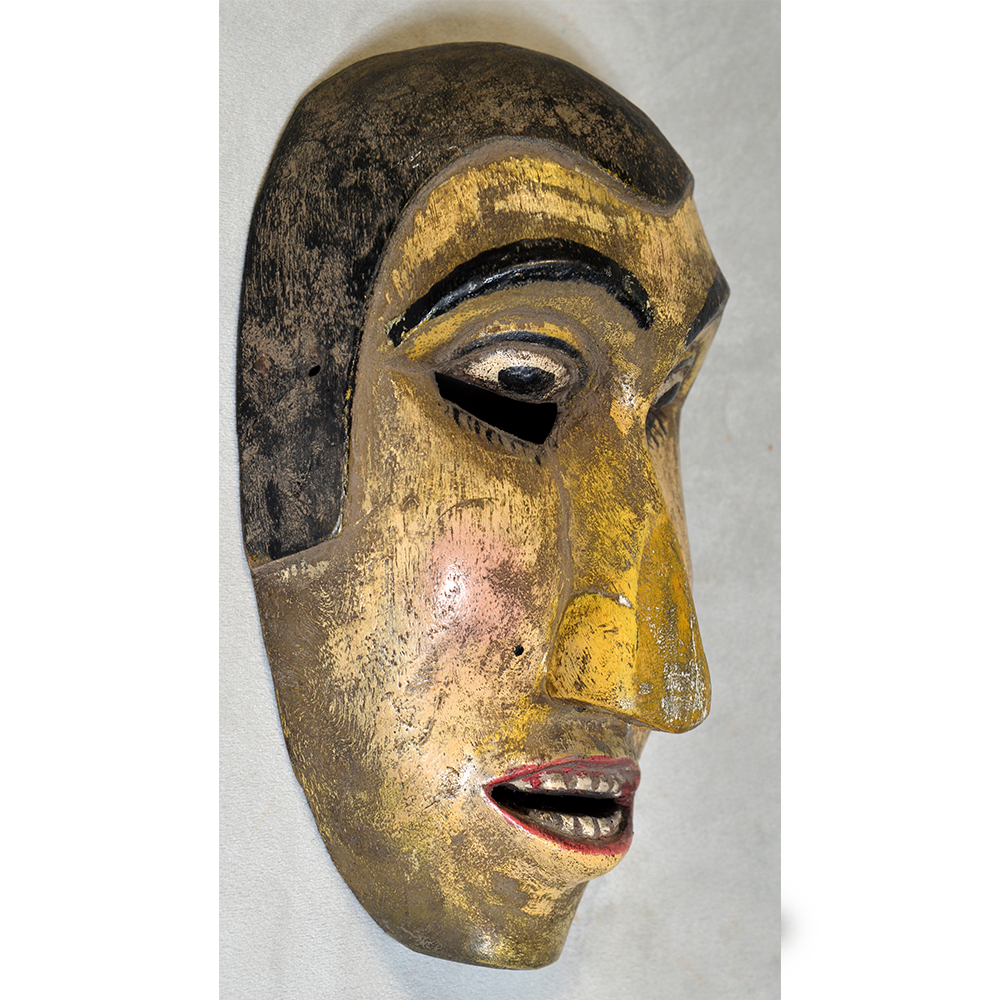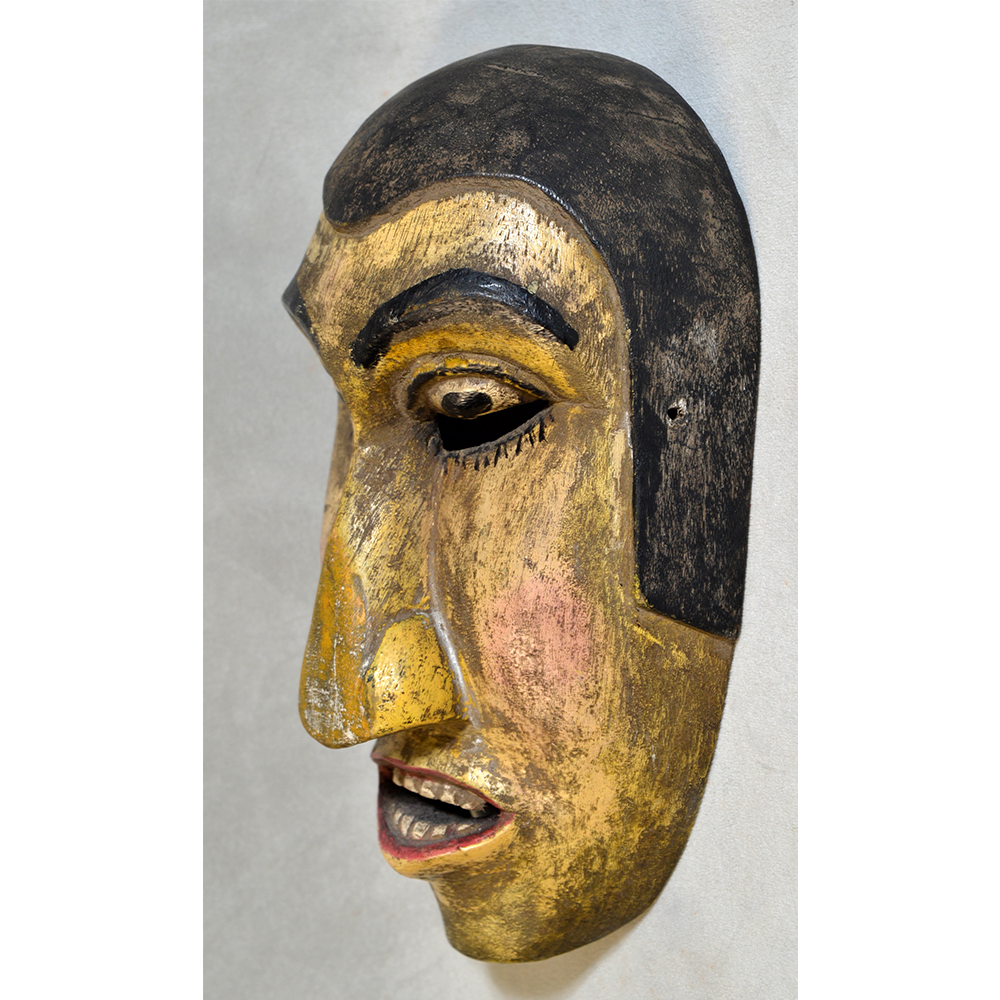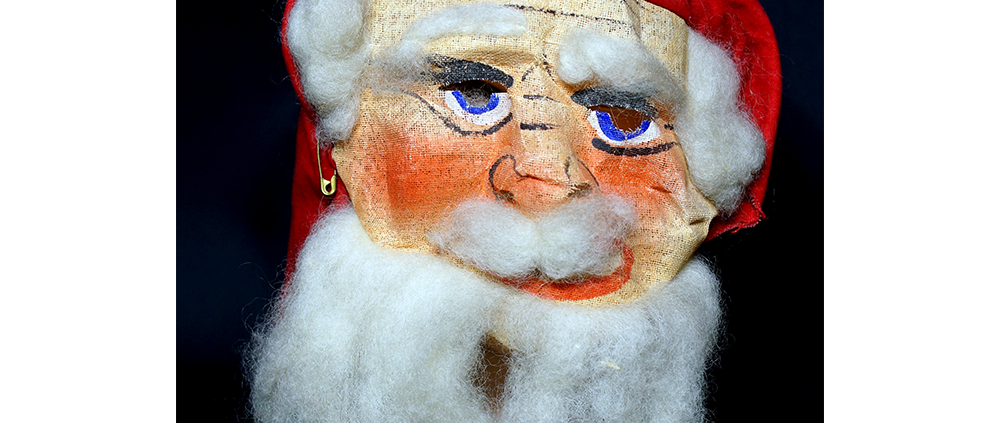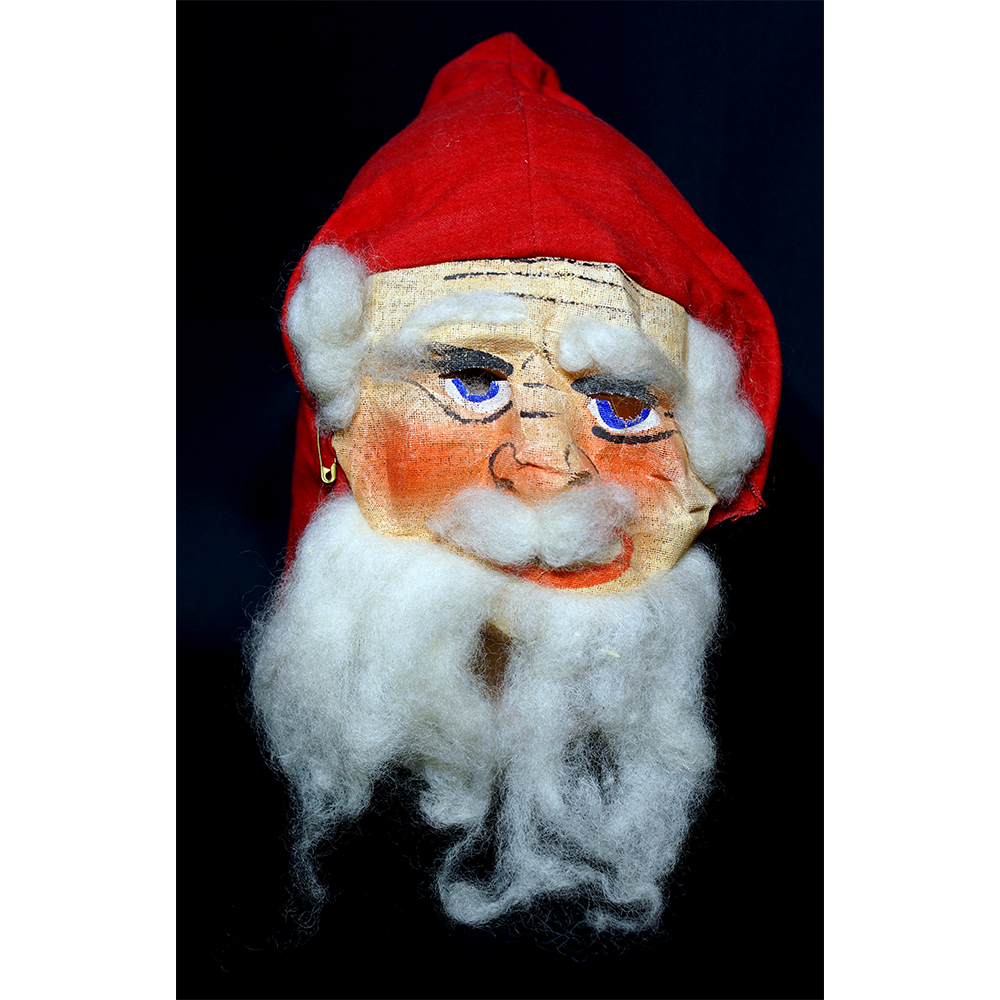
TITLE: Santa Claus Mask
TYPE: hood mask
GENERAL REGION: North America
COUNTRY: United States of America
SUBREGION: New York City
ETHNICITY: Mixed
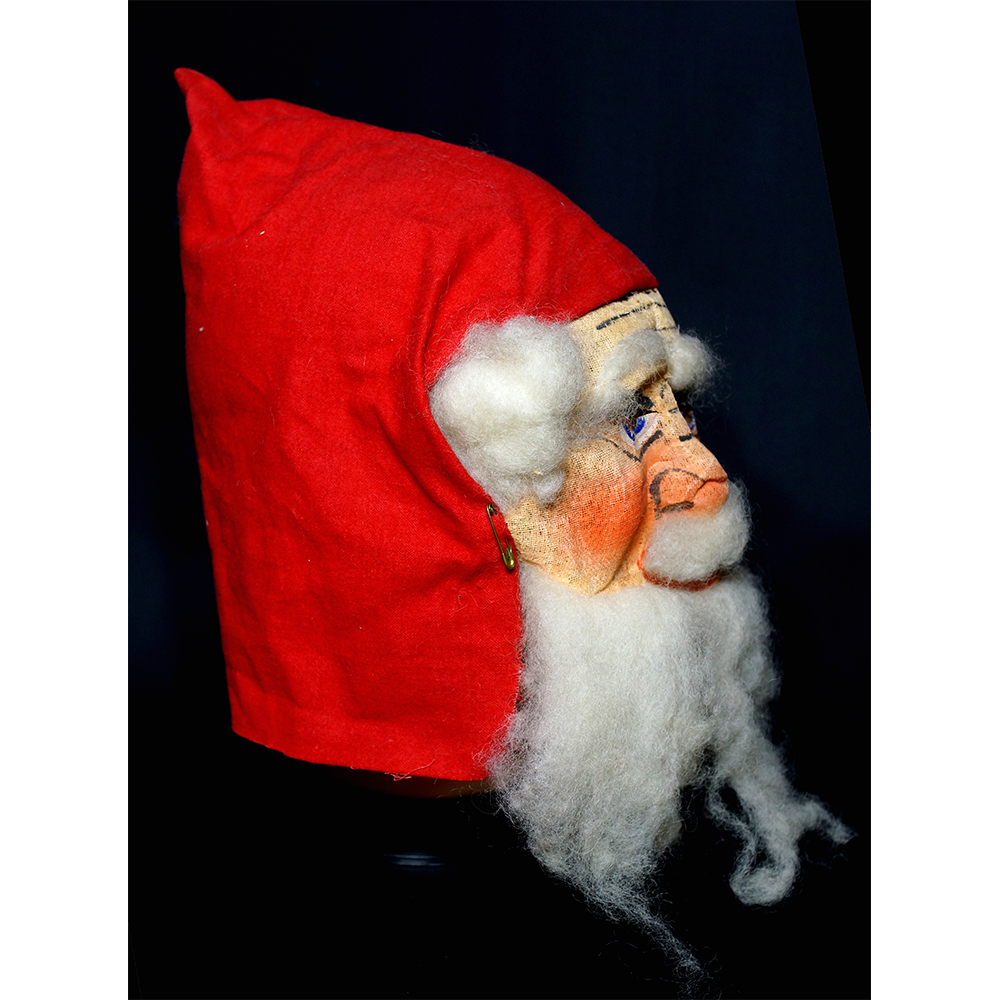
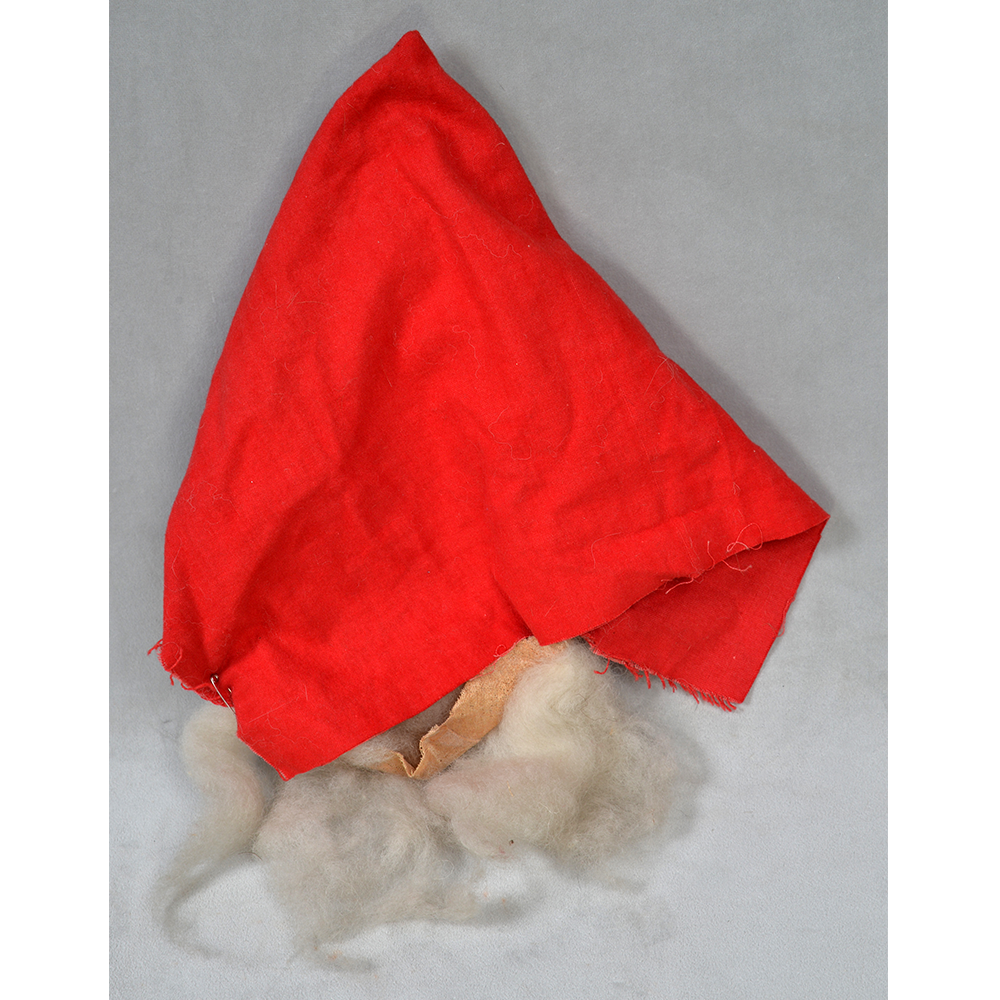
DESCRIPTION: Buckram Santa Claus mask
CATALOG ID: NAUS076
MAKER: Dessart Brothers, Brooklyn, NY
CEREMONY: Christmas
AGE: 1940s
MAIN MATERIAL: buckram
OTHER MATERIALS: paint; flannel hood; cotton batting

Christmas is the Christian celebration of the birth of Jesus of Nazareth, the principal Christian prophet, observed on the 25th day of December.  It is one of the most important Christian holidays.  In North American observance, heavy emphasis during the ceremony is placed on the Christian virtues of generosity and charity, expressed in part by gift-giving.  Gifts are left for family members in stockings symbolically hung to dry a chimney mantel or under a decorated tree.

The decorated tree is among the North American traditions brought over from Germany, where pre-Christian peoples had decorated trees with candles to celebrate Yule, the mid-winter ceremony.  To emphasize the additional Christian virtue of humility, gifts were not attributed to the actual giver, but to a supernatural visit from Saint Nicholas, a fourth century Greek bishop, whose image merged with the gift-giving Germanic father of gods, Wodan (Norse Odin), to because Santa Claus.

Like Wodan, Santa Claus has a long white beard and flies through the night sky to bring gifts. Germanic peoples have long celebrated in December by dressing up to represent some form of the Santa Claus character, and the Christians of the United States adopted the custom, primarily to present children with the image of a benevolent old man at parades, shopping malls, and parties.

This mask is an inexpensive, mass-produced buckram version, produced by the Dessart Brothers of Brooklyn, and presumably designed for private parties or home use, better to disguise the wearer. This specific mask was used in a classroom in the Midwest in the 1940s and 1950s for the benefit of school children.

:

TITLE: Hopi Koyemsi Katsina
TYPE: hood mask
GENERAL REGION: North American
COUNTRY: United States of America
SUBREGION: New Mexico
ETHNICITY: Hopi
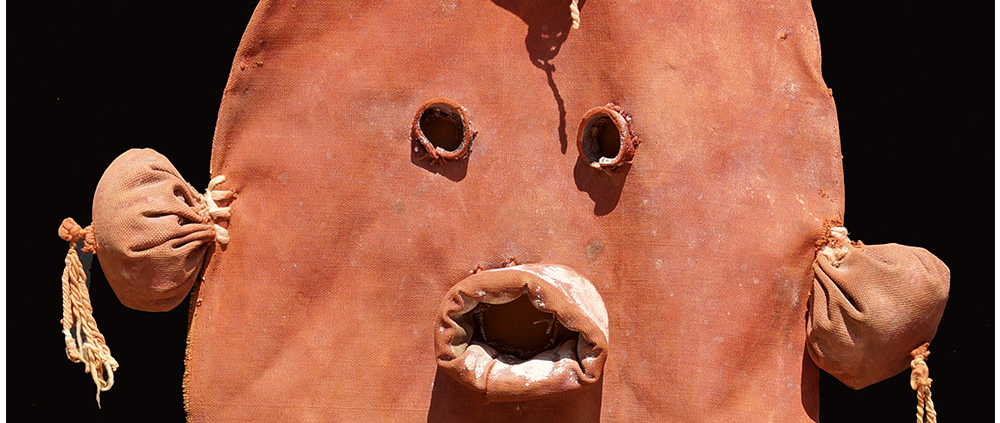
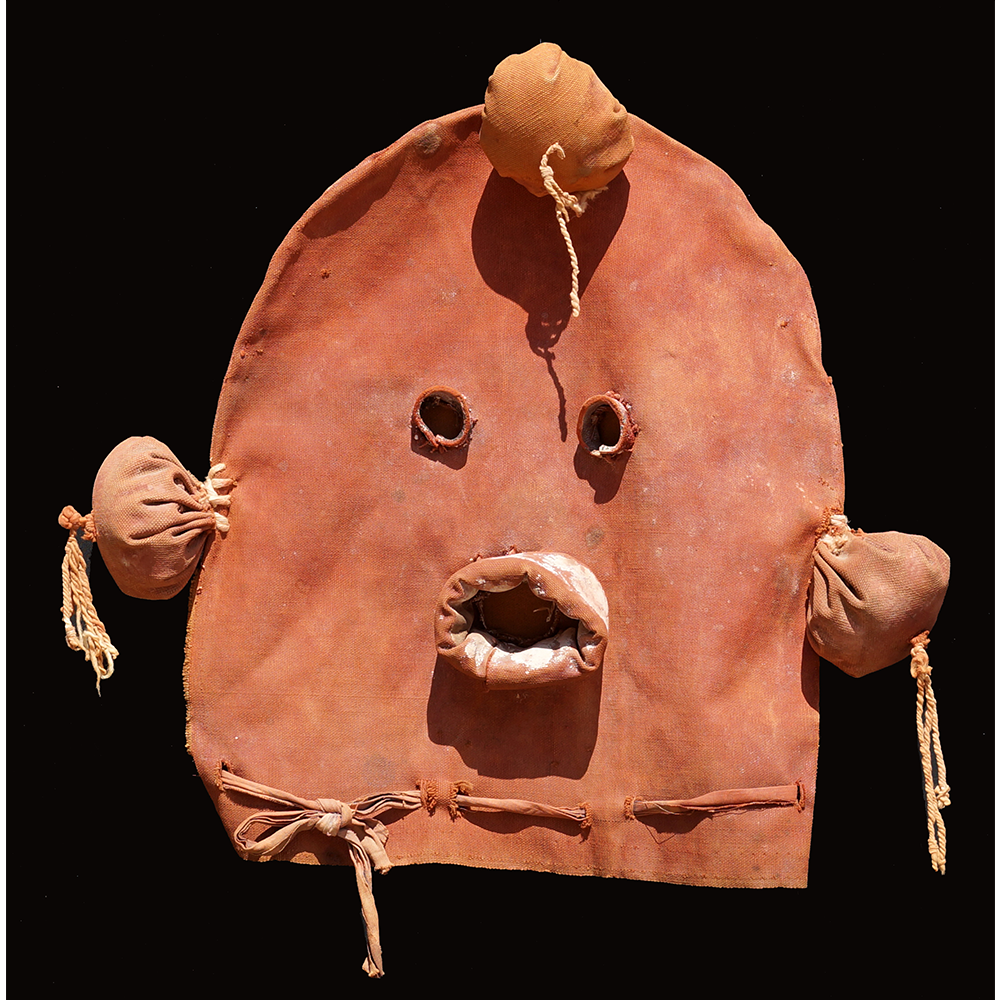
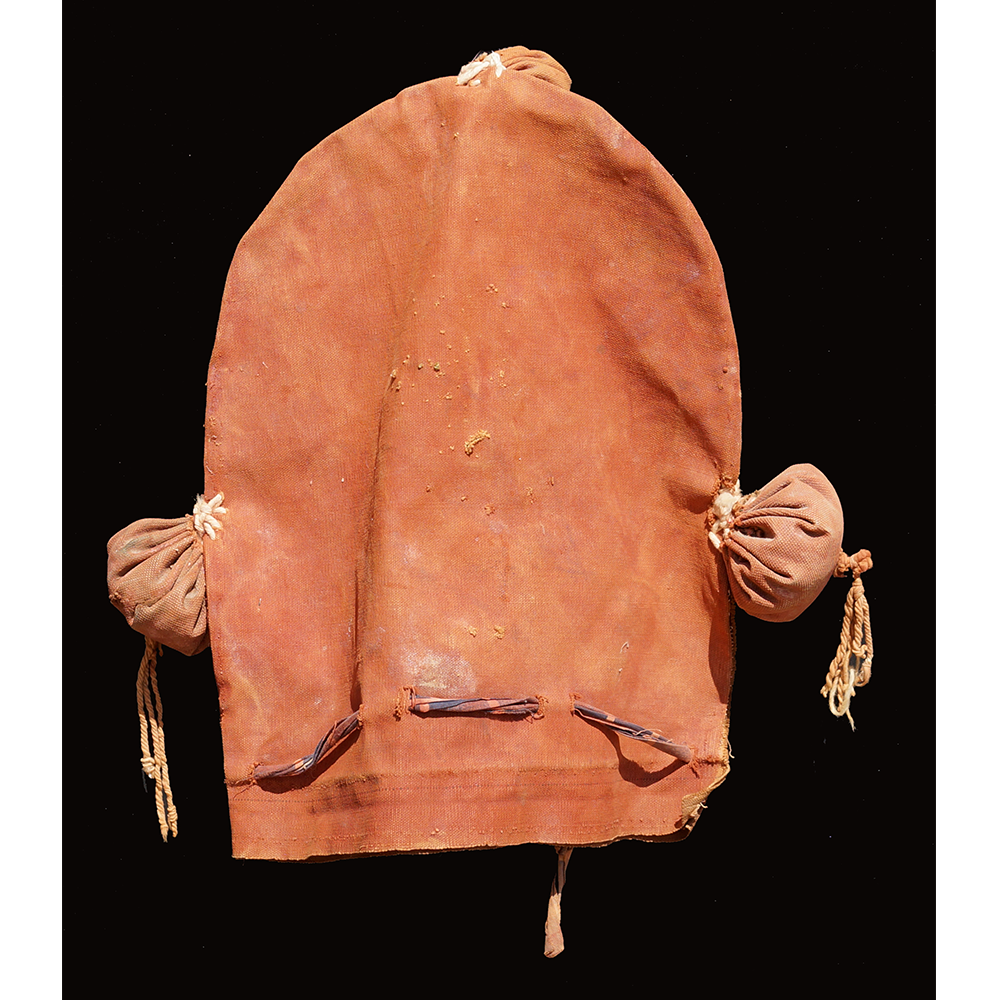
DESCRIPTION: Koyemsi (Mudhead) Katsina Mask
CATALOG ID: NAUS057
MAKER: Unknown
CEREMONY: Katsina Dance
AGE: mid-twentieth century
MAIN MATERIAL: linen
OTHER MATERIALS: cloth wadding; string; clay

Among the Puebloan nations of the southwest United States, the Hopi people of Arizona and New Mexico are known for their katsina (also spelled kachina) dolls, given to children to help them recognize the spirits that will protect and benefit the Hopi people. These dolls represent masked dancers who have assumed the form of spirits and gods, dancing at ceremonies from the winter solstice (December) to just after the summer solstice (July). The ceremonies especially focus on the planting season and ensuring a fruitful crop.  The katsina dancers perform important religious and social roles in purifying the village, policing Hopi behavior, and in some cases entertaining the audience.  They are also used in adult initiation ceremonies for boys.

Hopi society is infused with religion, in which the katsinam play a major role during half the year.  There are numerous dances and ceremonies involving the katsinam between February and August, including the Powamuya (Bean Ceremony) in February and talangva (summer solstice). Some of these ceremonies are complex, involving night visits by the katsinam to regulate village conduct, adult initiation of boys between 10 and 15 years into the Katsina Society, and dances during the daytime to increase the fertility of the crops and wildlife upon which the Hopi depend.
Both the Hopi and Zuñi nations use the koyemsi katsina. Koyemsi translates roughly to “mudhead.” The character has slightly different meanings to different nations. To the Hopi, the koyemsi represents the first being to emerge onto the earth from a sipapu, which is why he is covered in mud. Unlike other katsinas, he does not represent a god spirit.  The koyemsi appears in most dances and plays multiple important social roles, from policing behavior to clowning. The koyemsi may drum, dance, play games with the villagers, or award prizes for the races and guessing games they organize. For example, a koyemsi leads the Hototöm (racing katsinam), who challenge village men and boys to races in early spring, and he carries food prizes wrapped in a blanket for the winner. Koyemsimu also organize groups of singers, who sing to other katsina groups and bring them gifts.
:

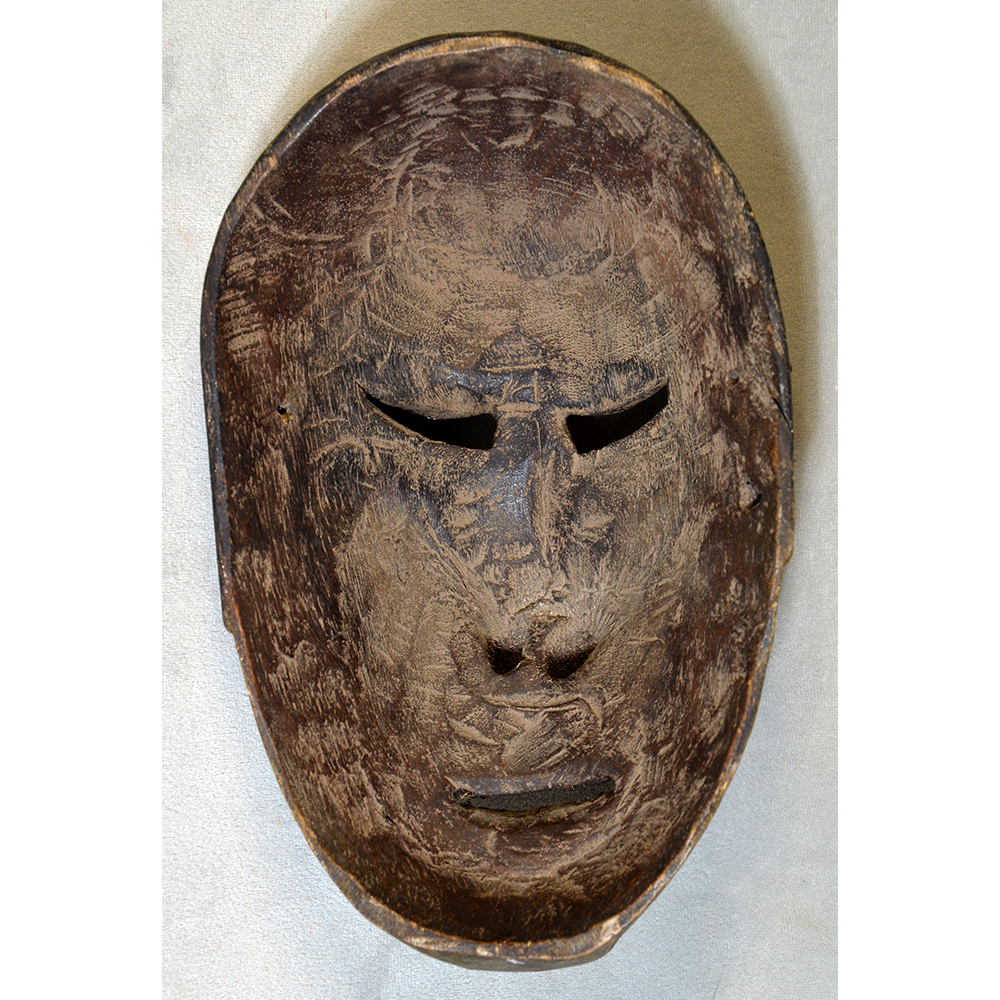
TITLE: Female Huehue
TYPE: face mask
GENERAL REGION: Latin America
COUNTRY: Mexico
SUBREGION: Puebla
ETHNICITY: Nahua & Mixtec
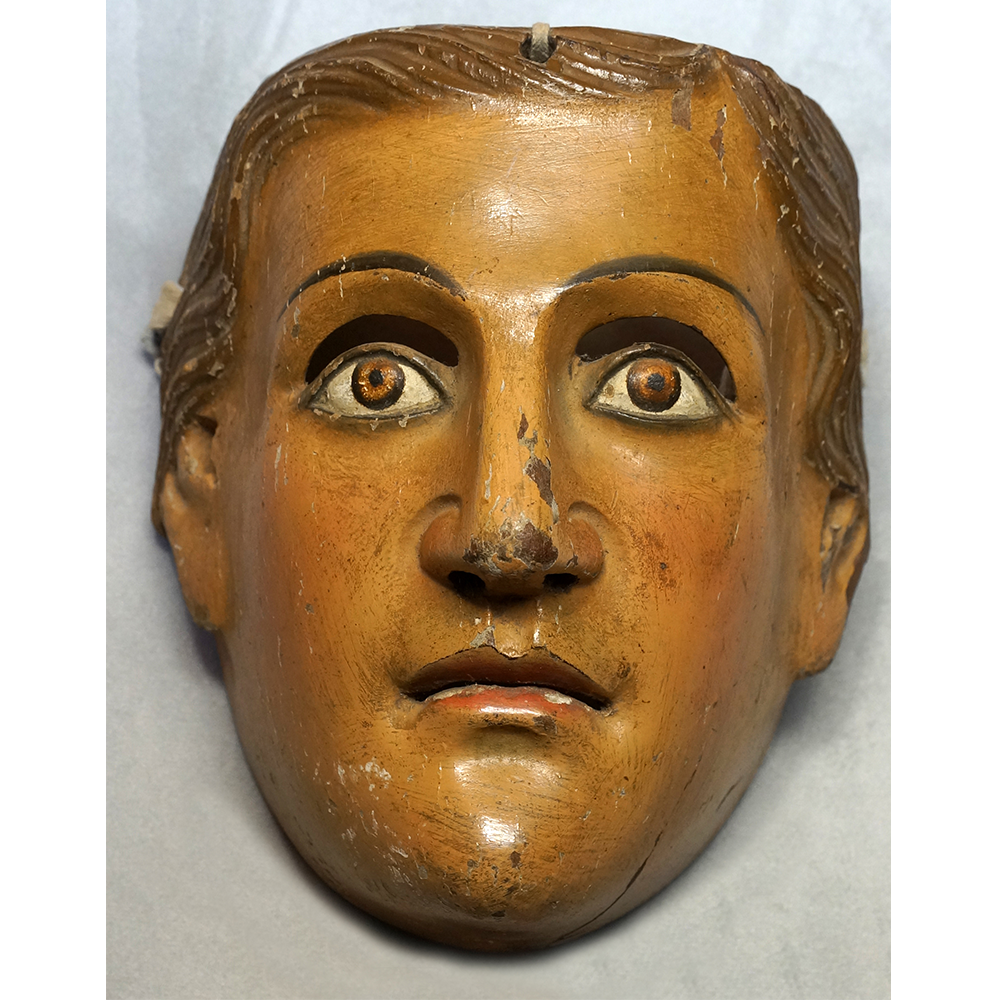
DESCRIPTION: Female Huehue (Elder) Mask
CATALOG ID: LAMX094
MAKER: Magno León (Huetlalpan, 1914-1977)
CEREMONY: Danza de los Huehues
AGE: ca. 1950
MAIN MATERIAL: wood
OTHER MATERIALS: oil-based paint; elastic bands

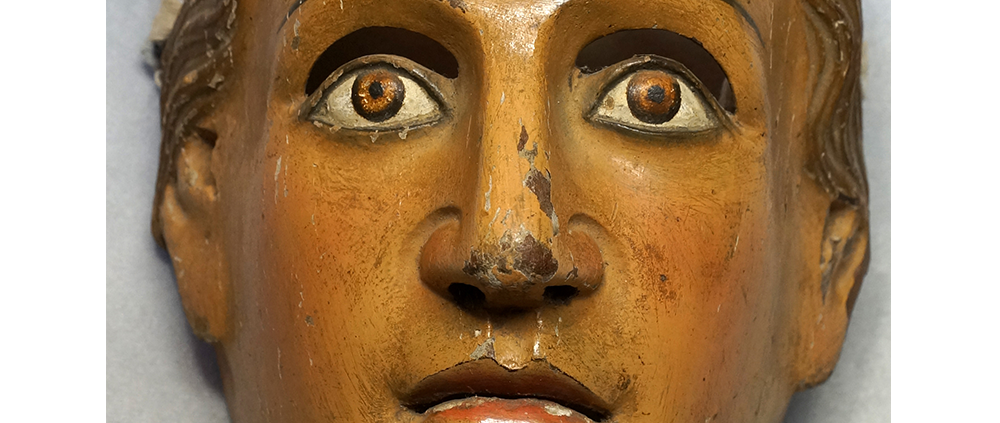
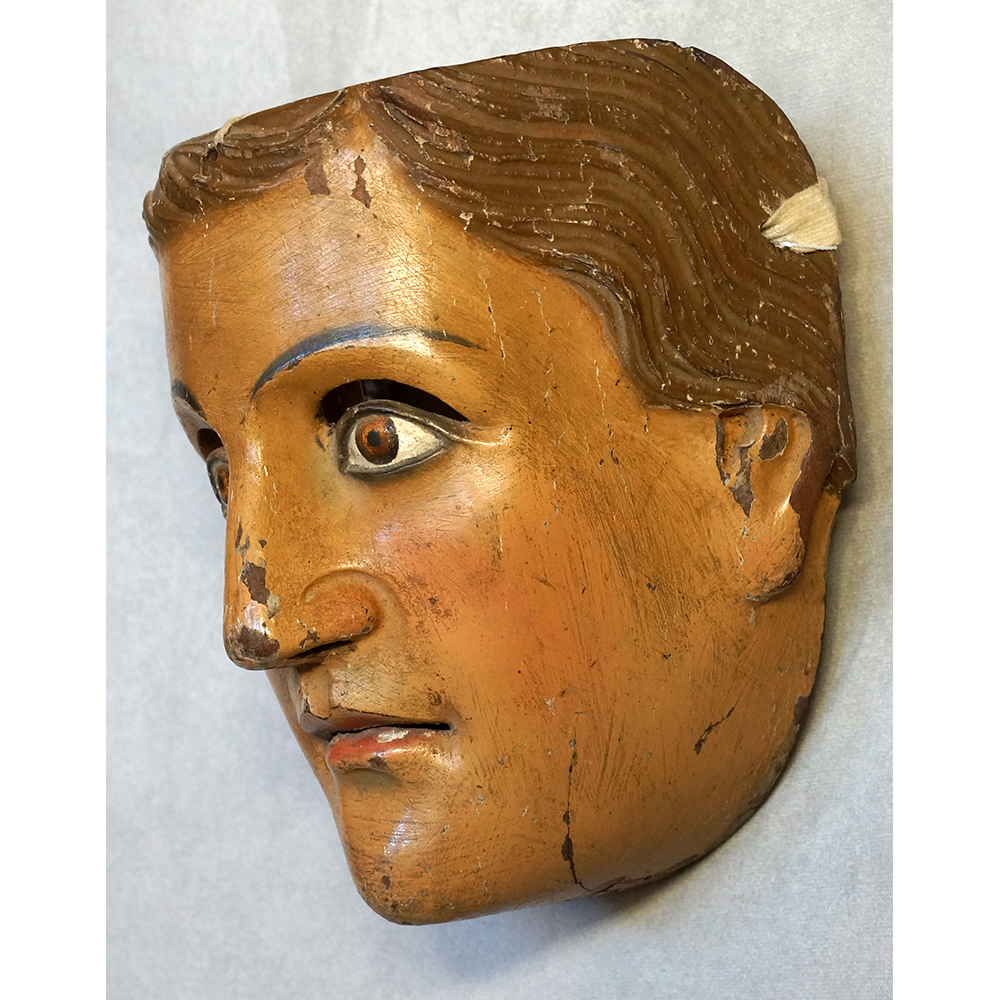
Huehue means village elder.  The Danza de los Huehues predates the Spanish conquest and is believed to have begun around Day of the Dead, when village elders helped the widows to find shelter after their husbands died in battle.  Some believe the dance originated in Tlaxcala or Huasteca and spread to Puebla.  The Devil is a character added by way of Catholic influence; he is charged with harassing the dancers and audience during the performance.

Most huehue masks are male, but some female huehues such as this one are danced as well.  The dance is typically held in late June, in honor of a patron saint.

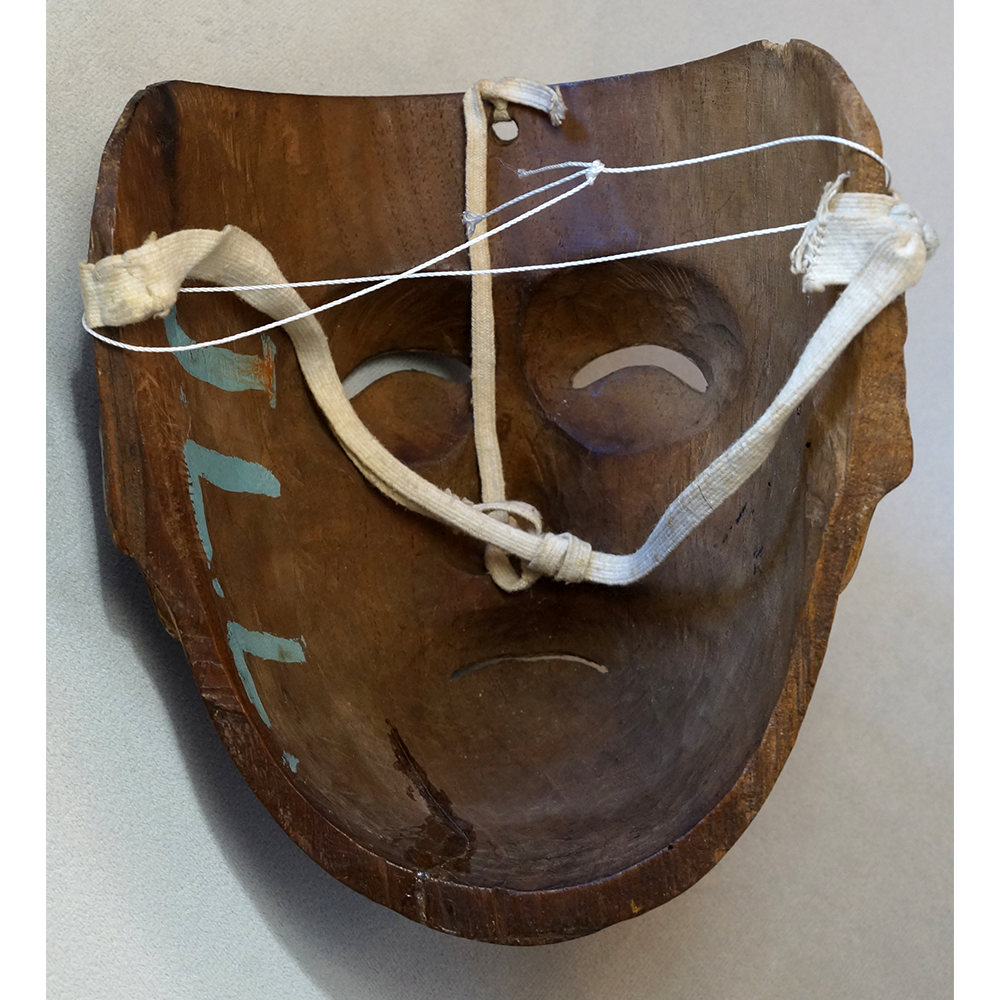
This mask was carved by a master sculptor and used for many years. One former owner so prized the mask that he painted his initials, J.L.L., on the inside.

For more on masks from Puebla, see Bryan J. Stevens, Mexican Masks and Puppets: Master Carvers of the Sierra de Puebla (Atglen, Pennsylvania: Schiffer Pub’g, 2012).

:

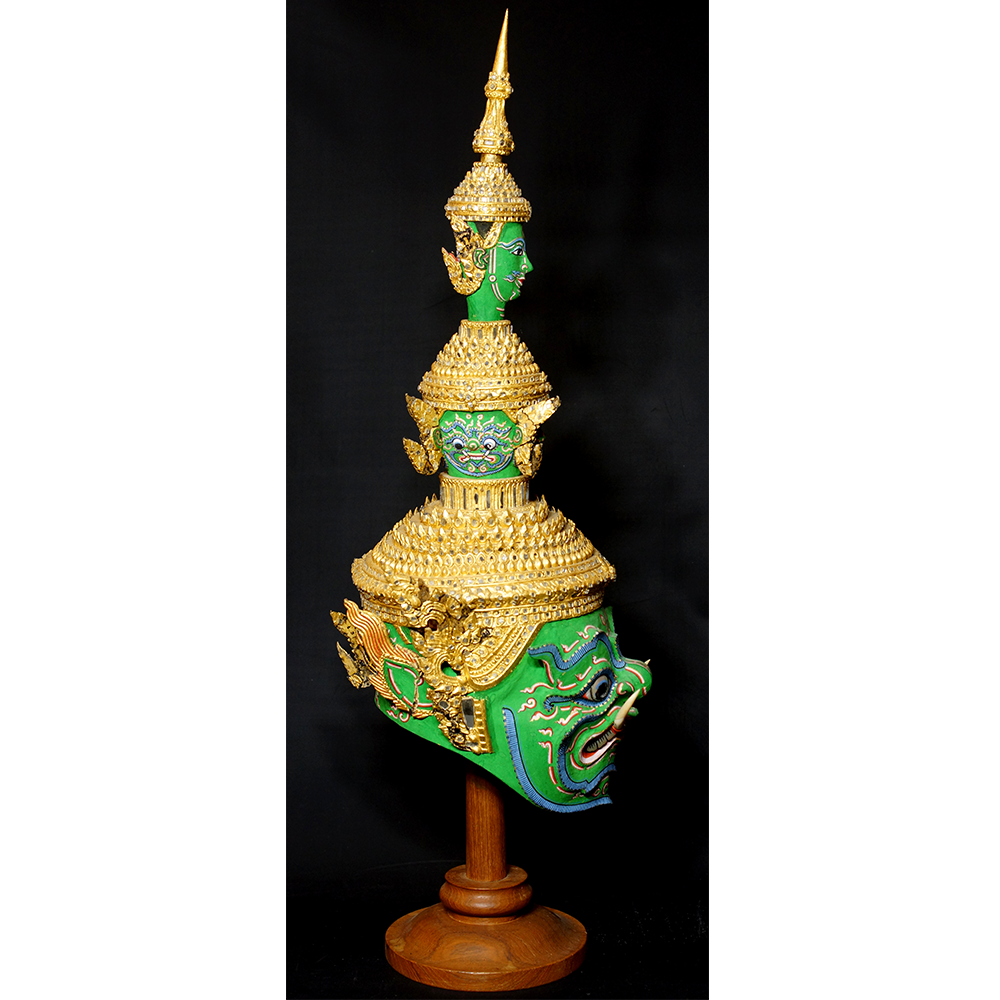
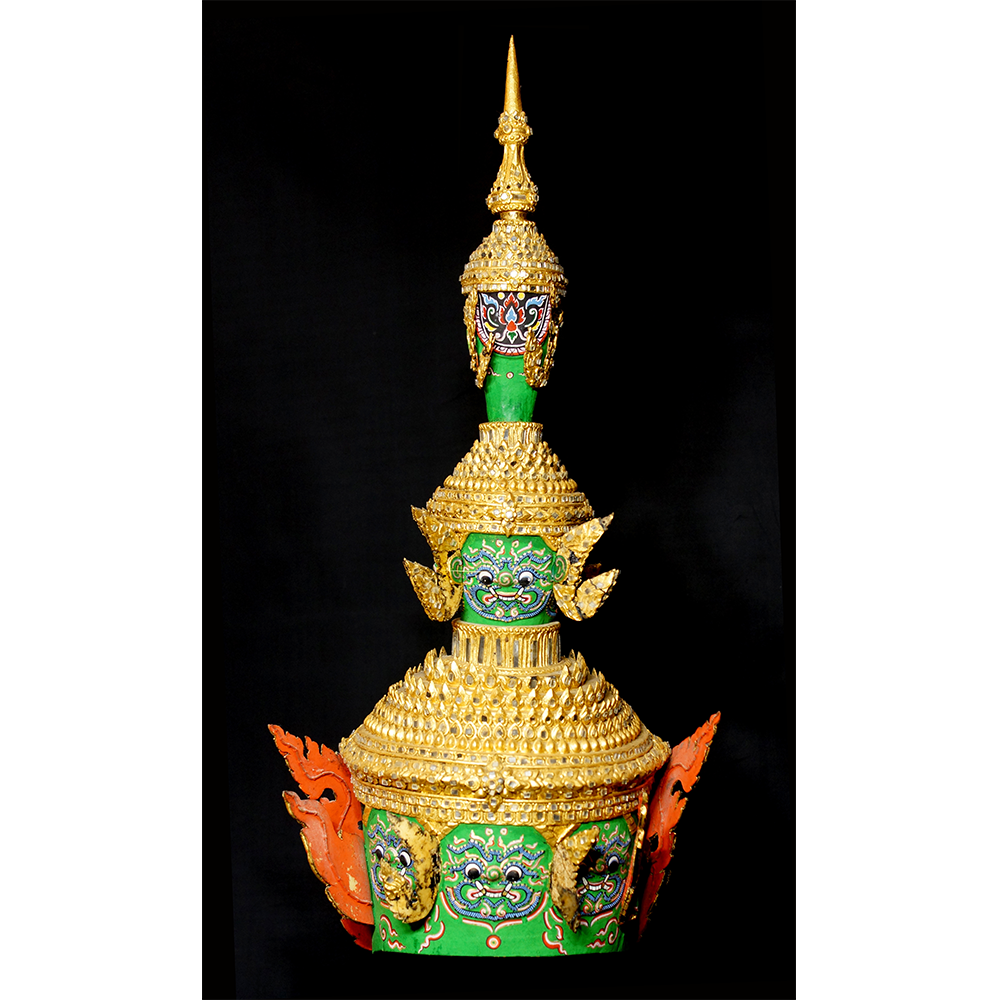
TITLE: Totsakan Khon Mask
TYPE: helmet mask
GENERAL REGION: Asia
COUNTRY: Thailand
SUBREGION: Bangkok
ETHNICITY: Thai
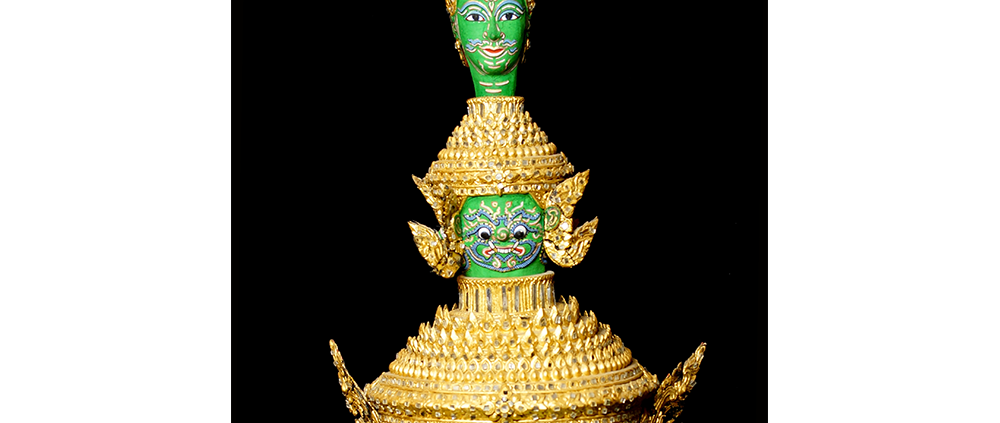
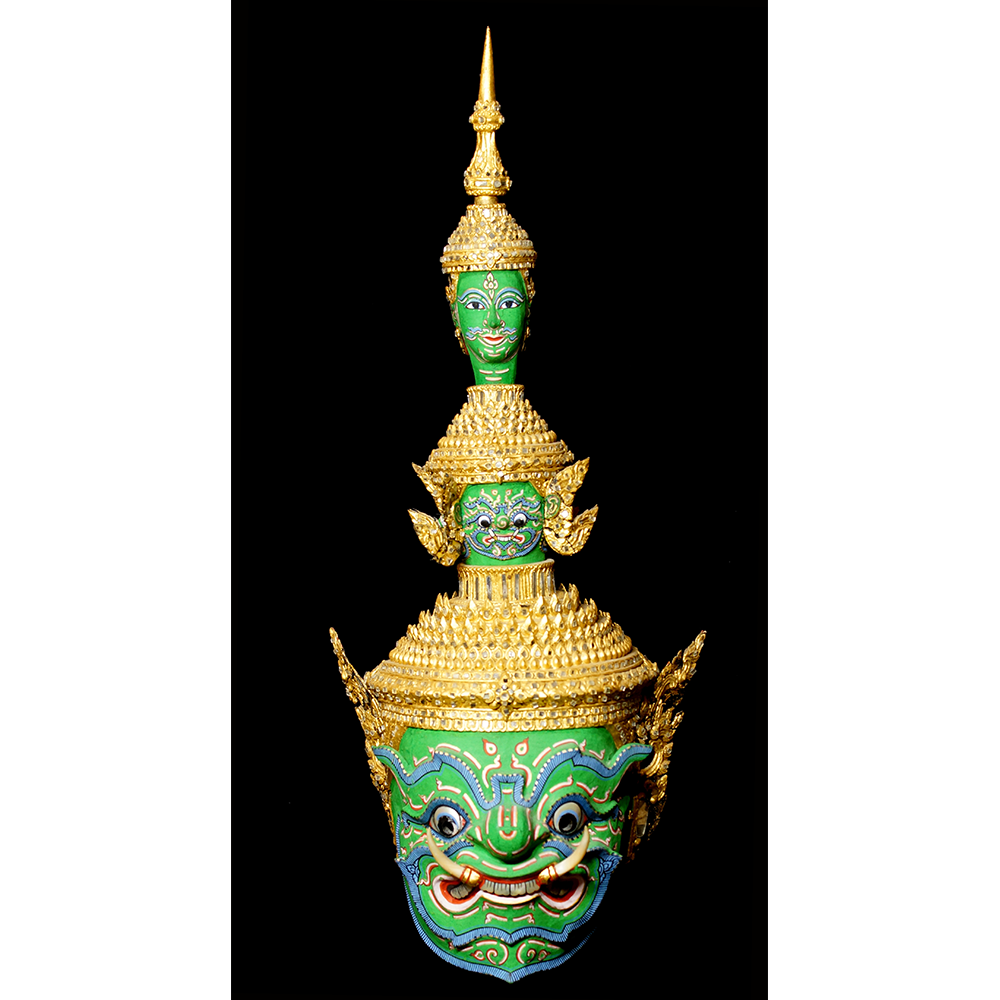
DESCRIPTION: Totsakan (Green) Khon
CATALOG ID: ASTH004
MAKER: Unknown
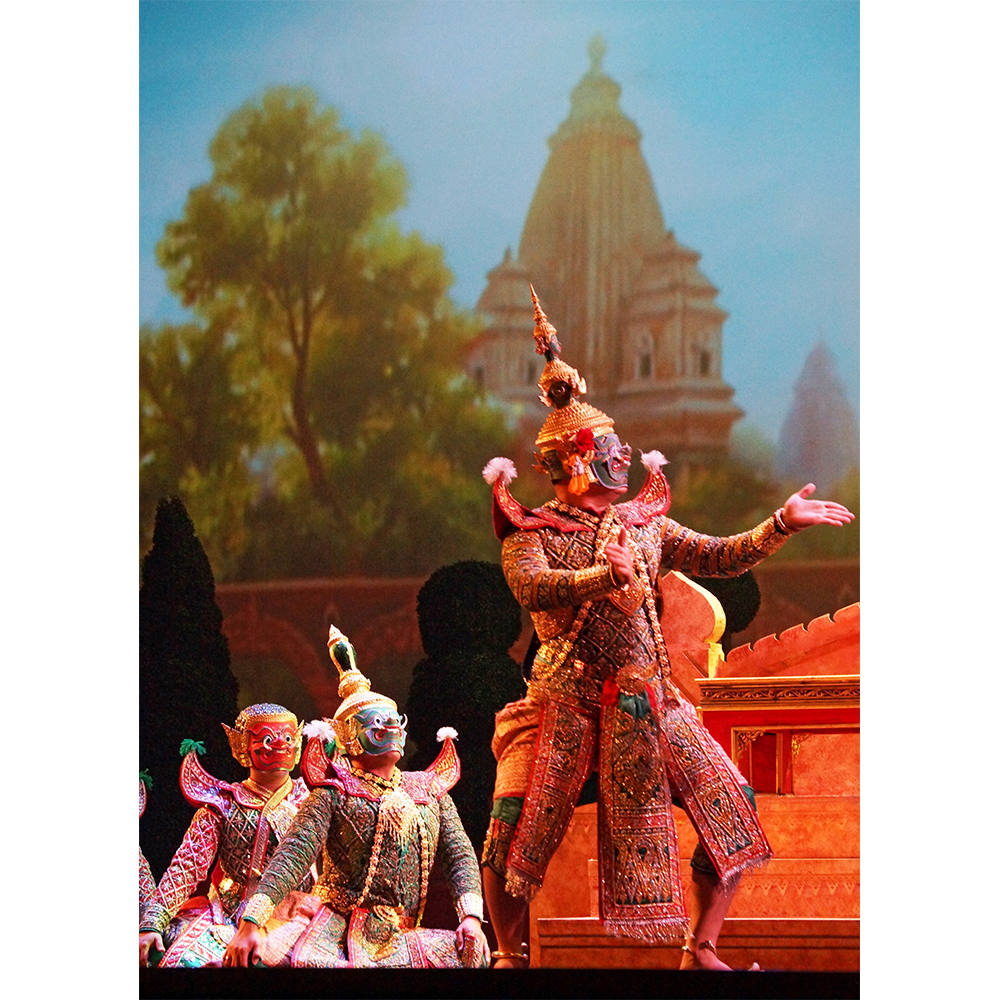
CEREMONY: Ramakien Dance Drama
AGE: 1960s
MAIN MATERIAL: paper maché
OTHER MATERIALS: plaster; gilding; mirrors; paint; mother-of-pearl teeth; wooden fangs

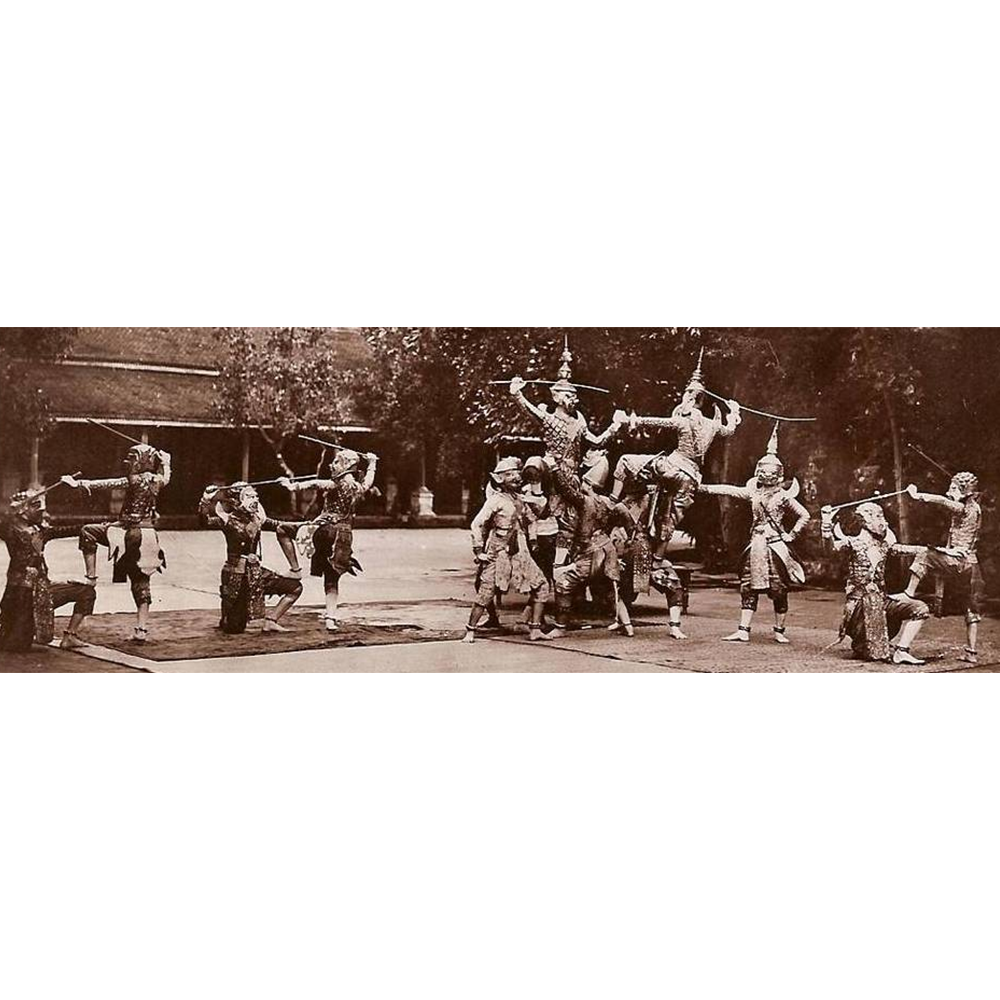
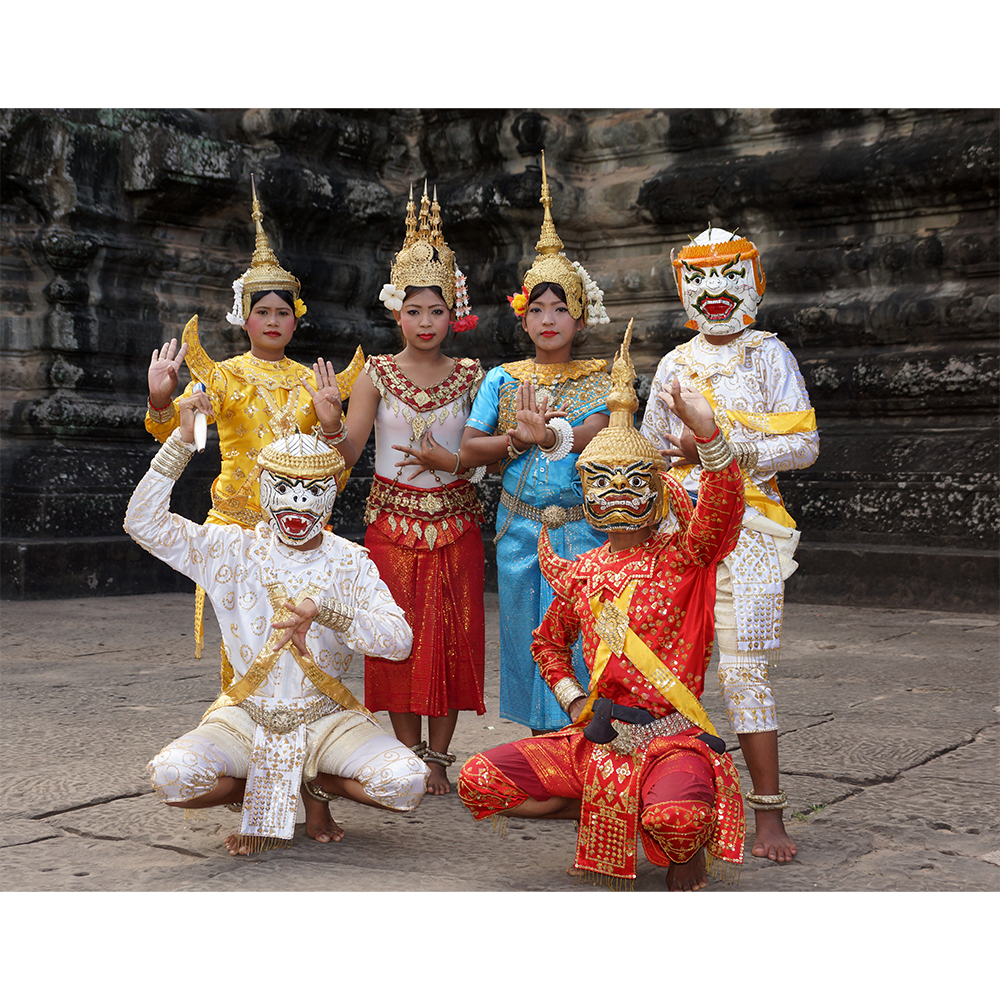
The Ramakien is the Thai adaptation of the traditional Hindu epic from India, the Ramayana.  Most male characters in the drama wear masks fashioned from paper maché and elaborately gilded, decorated, and painted.

This mask represents the demon king Totsakan, also written Tosakanth (or Ravana in Hindi), who is supposed to have 100 faces and 20 hands. His face is green during most of the play, but when he ascends to power his face turns gold.  Totsakan is the villain at the center of the Ramakien, as he abducts Sita, the beautiful wife of the hero, King Rama.  The remainder of the play focuses on Rama’s efforts, with his loyal demigod ally Hanuman, to rescue Sita and punish Totsakan.

For more on Thai khon masks, see Natthapatra Chandavij & Promporn Pramualratana, Thai Puppets and Khon Masks (Bangkok: River Books, 1998).

:

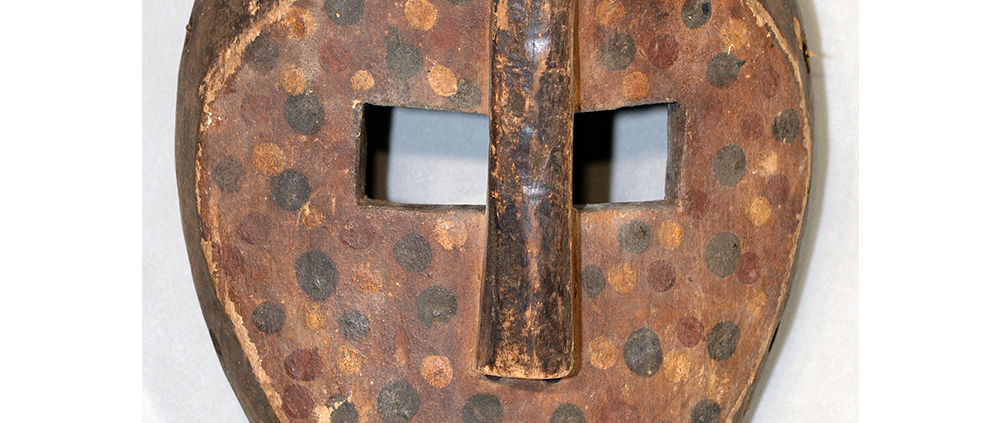
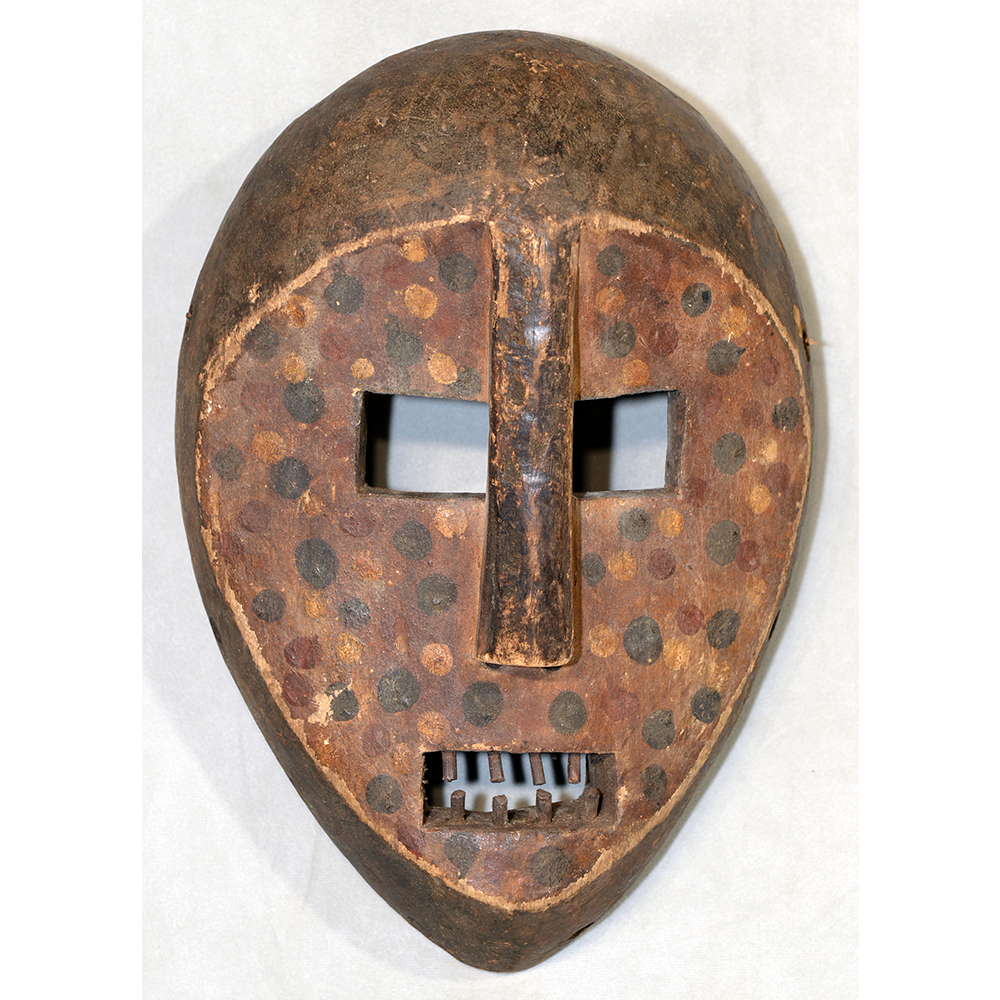
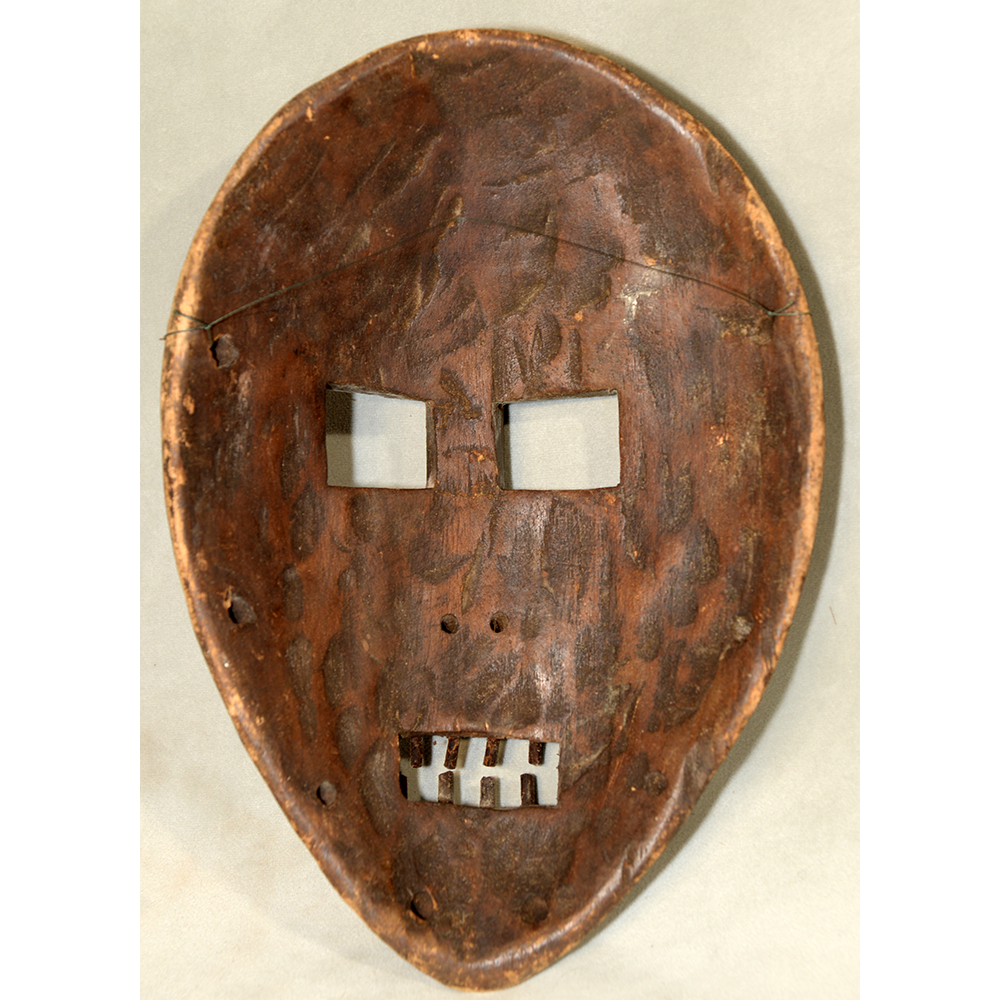
TITLE: Kumu Nsembu Mask
TYPE: face mask
GENERAL REGION: Africa
COUNTRY: Democratic Republic of Congo
ETHNICITY: Kumu
DESCRIPTION: Nsembu Nkunda Society Mask
CATALOG ID: AFCD019
MAKER: Unknown
CEREMONY: Secret Society; Adult Initiation; Divination
AGE: 1980s-1990s
MAIN MATERIAL: wood
OTHER MATERIALS: kaolin; pigment

The Kumu or Komo people inhabit the Ituri rainforests in the eastern part of Congo.  They are agriculturalists with animist traditions.

A culturally important ritual for the Kumu people is the circumcision of boys as they enter adulthood.  The nsembu mask is used exclusively by members of the Nkunda Secret Society for the purposes of adult initiation. They also use the mask for divination under the effects of hallucinogens.  The mask itself represents the diviner’s spirit.  Kumu masks are somewhat rare, but the known examples tend to have wide open eyes and mouths, frequently with sharp teeth.

:

TITLE: Waggis Carnival Mask
TYPE: helmet mask
GENERAL REGION: Europe
COUNTRY: Switzerland
SUBREGION: Basel
ETHNICITY: Swiss
DESCRIPTION: Waggis (Alsation) Carnival helmet mask with hat
CATALOG ID: EUCH006
MAKER: Unknown
CEREMONY: Fasnacht (Carnival)
AGE: ca. 1970s
MAIN MATERIAL: paper maché
OTHER MATERIALS: paint; plastic hair; wool hat

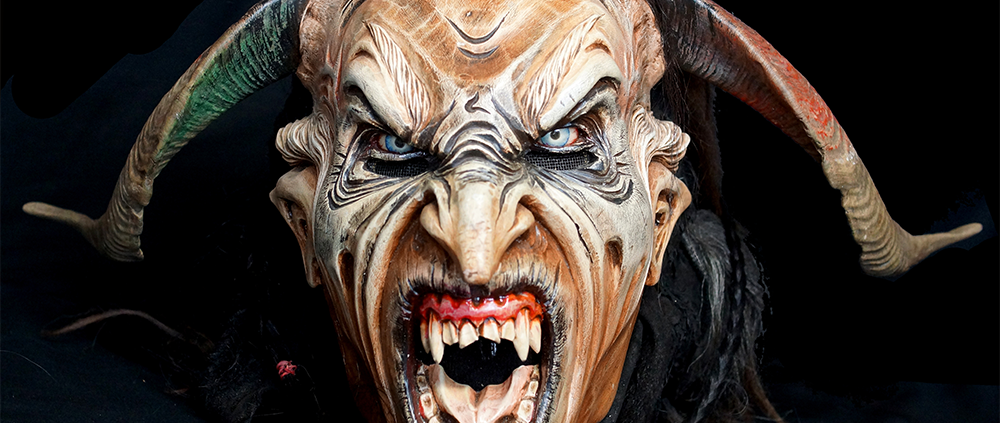
Fasnacht is what the Tyrolean Swiss call Carnival.  In many towns in Austria, southern Germany, Switzerland, and northern Italy, local folk don elaborate masks and costumes to parade through the town.  Different towns have variations on the parade, such as the Schemenlaufen of Imst, the Schellerlaufen of Nassereith, and the Muller and Matschgerer of Innsbruck, Austria.

In Basel, Switzerland, masks are almost all made of paper maché and take a helmet form. Armies of costumed clowns, musicians, and dancers, called cliques, parade around town in uniform mask styles for 72 nearly continuous hours on the Monday following Ash Wednesday. The paraders must wear their Larven (masks) throughout the parade and are expected never to remove the mask in order to identify themselves.  They throw confetti at crowd members with such proliferation that it blankets the streets.

Although there is a great deal of innovation and creativity in mask styles, there are certain styles that tend to reappear annually. This mask, known as Waggis, represents a big-nosed, frizzy-haired clown, who wears wooden clogs, a blue shirt, and a red neckerchief. He is a prankster who parodies the Alsatian farmers who formerly came to Basel market days to sell their produce (Waggis literally means a person from Alsace in Basel dialect). It was worn for several decades and retired after the 2010 parade.

Other common characters include the Alti Dante (old aunt), Dummbeeter (trumpetist) and Pierrot (a sad clown from the late Italian Commedia dell’Arte, known for his white and black makeup).

:

TITLE: Ogoni Mami Wata Mask
TYPE: face mask
GENERAL REGION: Africa
COUNTRY: Nigeria
ETHNICITY: Ogoni
DESCRIPTION: Ogoni Mami Wata face mask
CATALOG ID: AFNG002
MAKER: Unknown
CEREMONY: Agriculture; Funeral
AGE: 1970s
MAIN MATERIAL: wood
OTHER MATERIALS: paint

The Ogoni people have managed to maintain much of their precolonial culture, including their masquerading traditions.

Masks are used for funeral celebrations and to celebrate the harvesting of yams.  The Mami Wata represented here is a water goddess important to many northwest African cultures. She is sometimes represented by a mermaid but is nearly always surrounded by snakes, as here.

:

TITLE: Nafana Bedu Mask
TYPE: plank mask
GENERAL REGION: Africa
COUNTRY: Côte d’Ivoire
ETHNICITY: Nafana
DESCRIPTION: Bedu Association Male Plank Mask
CATALOG ID: AFCI022
MAKER: Unknown
CEREMONY: Secret Society; Purification; Celebration; Funereal; Agriculture
AGE: early 2000s
MAIN MATERIAL: wood
OTHER MATERIALS: kaolin; pigment

The Nafana people of Côte d’Ivoire and Ghana have developed a Bedu Secret Society only in the last century. It is probably a successor to the Sakrobundi Secret Society banned by the British due to the Society’s function of violently punishing supposed sorcerers.  The Bedu society is charged with the less malignant function of village purification during a month-long new year’s celebration annually, as well as during harvest festivals and funerals.  The bedu itself represents a mythical ox-like beast that, in Nafana myth, cured a sick child and later disappeared into the bush.  Although these masks are worn over the face, their exceptional size requires them to be made of relatively light wood.

Bedu masks come in both genders, with the male masks (such as this one) having horns, and the female having a circle or disc on top. Most such masks of either gender are painted in kaolin clay with abstract geometrical patterns, checker marks and jagged fins being favored.  Sometimes red, blue, or black pigments are used as well.

:

TITLE: Dayak Demon Mask
TYPE: face mask
GENERAL REGION: Oceania
COUNTRY: Indonesia
SUBREGION: Borneo
ETHNICITY: Dayak
DESCRIPTION: Dayak Demon Bukong
CATALOG ID: OCID003
MAKER: Unknown
CEREMONY: Unknown
FUNCTION: Agriculture; Purification
AGE: 1880s
MAIN MATERIAL: wood
OTHER MATERIALS: pigment

Not much is known about the masked ceremonies of the South Kalimantan region of Borneo. This mask dates to the late 19th century and represents a demon.  Stylistically, it shows traces of Hindu influence from Javanese settlers, transmitted to the settlers from Indian traders in previous centuries.  Such masks were most probably used to drive away evil spirits from the village during important ceremonies, such as funerals, and from crop fields.

:

TITLE: Teke Kidumu Mask
TYPE: plank mask
GENERAL REGION: Africa
COUNTRY: Democratic Republic of Congo
ETHNICITY: Teke
DESCRIPTION: Teke Kidumu Society plank mask
CATALOG ID: AFCD021
MAKER: Unknown
CEREMONY: Adult Initiation; Funeral; Secret Society
AGE: 2000-2005
MAIN MATERIAL: wood
OTHER MATERIALS: kaolin; pigment

The Teke people of the Democratic Republic of Congo (formerly Zaire) established a kingdom in the 8th century on the Zaire River, ruled by a monarch whose authority is primarily spiritual. Political power is exercised by a structure of regional and village clan chiefs. Chiefs and priests, always men, belong to Mungala Society.

The Kidumu Secret Society, composed solely of adult men, plays a central role in adult initiation rituals, funerals and other major village events.  In the northwest region of their territory, a dancer from the Kidumu Society wears an abstract plank mask of the kind shown here, with a costume of raffia fiber and feathers to hide the body. The mask is associated with a bush spirit known as “Nkita.” Representing the spirit, the masquerader enters the village from the forest and dances an energetic cartwheeling dance alone to music rather than in a group before retiring again to the forest.

: