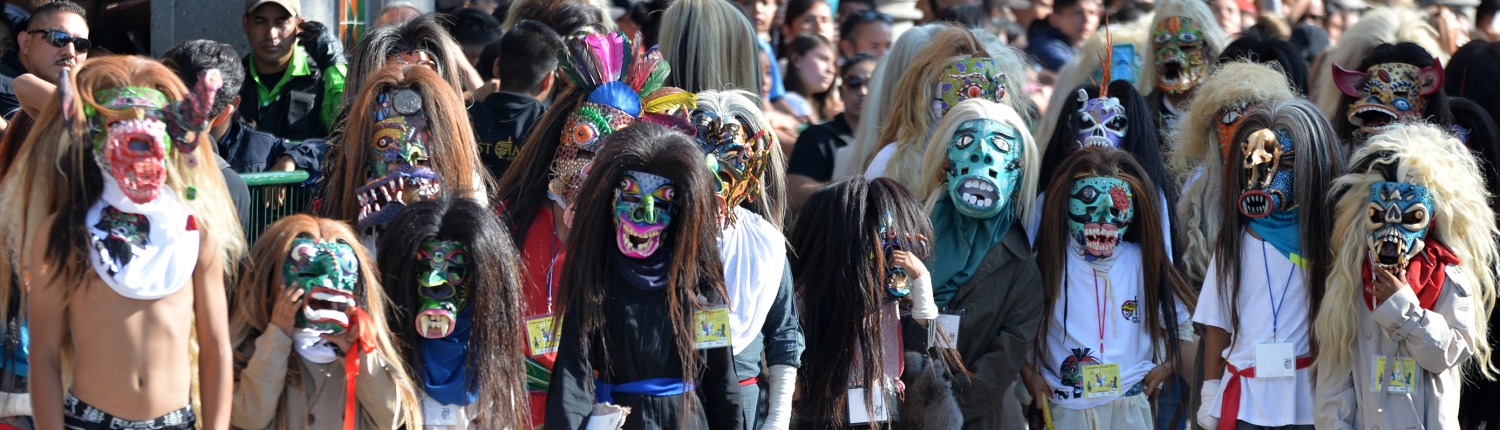
The appearance of racial and ethnic stereotypes in masquerade is common in Latin America, the Caribbean, North America, and Europe (they are much less common in Asia and Africa). Masks depicting persons of African origin, indigenous peoples, Asians, Jews, and others frequently exaggerate and distort facial characteristics. Blacks may be depicted with enlarged lips, bulging eyes, coal-black skin, and noses so flat as to defy notice. Asians are depicted with yellow skin, buck teeth, eyes narrowed to mere slits, and a fatuous smile. Indigenous peoples are represented either as impassive but elaborately decorated with animal parts (the “noble savage” stereotype) or fierce and implacable (the “true savage” stereotype), in either case with culturally inaccurate war paint. Jews may be depicted with fancifully enlarged noses, jewelry (reflecting the trope of Jews as wealthy or obsessed with money), and long beards. Romani people (formerly called “gypsies”) are depicted as either filthy beggars or exotic temptresses. And so forth.
The reliance of such stereotypes has diminished in North America and Europe in the last half-century, but such masks can still be found widely in use even on those continents. Given that these stereotypes might appear offensive and dehumanizing to the portrayed race or ethnicity, why have they not disappeared as sensibilities about equal human dignity and the importance of nondiscrimination have sharpened?
There is no single answer, because societies have adopted stereotyped mask morphologies for different reasons. In general, there are four explanations for the persistence of such stereotypes, ordered from least to most morally justifiable:
- Persistent racism
- Iconography based on ignorance
- Satire of an oppressor
- Reference to the culture’s own ancestry
I will discuss each briefly in turn.
Persistent Racism
The least justifiable explanation for the persistent adoption of racial and ethnic stereotypes is that, in some societies, majority racism persists and, in some cases, has experienced a resurgence. In the United States, the United Kingdom, and mainland Europe, white mask makers and wearers have frequently chosen masks that represent minority groups in grotesque ways. In some cases, the intention may be to demean and humiliate the stereotyped group, but more often the depiction results from unconscious racism. The participants in masquerade may feel that the racial or ethnic stereotype is merely fun or comical, and not intended maliciously. Yet, the reality is more complex and less excusable than they would wish. In some cases, they are just mindlessly expressing learned racism. In others, they are driven by dark psychological drives. It is an unfortunate fact of human psychology that all nearly persons have a deeply felt desire for self-esteem, and many persons can identify few sources for self-esteem in their lives. They may not be able to boast of material success, social popularity, educational achievement or the deep respect of their communities. Racism allows them to obtain unearned self-esteem by feeling superior to others based on purely arbitrary characteristics (race or ethnicity). The accomplished scholar W.E.B. Du Bois called this the “public and psychological wage” of whiteness, but any majority race or ethnicity can seek and obtain such wages by demeaning minorities. Stereotypical masquerade serves as an expression of this racism and thereby satisfies a psychological need of the mask wearer, in a tragically sociopathic manner that harms groups already vulnerable to persecution and oppression.
Ignorant Iconography
In some societies, particularly in the Caribbean and Latin America, but also in parts of Europe, stereotypical masquerade is not so much the result of racism and ethnocentrism as part of a tradition based on ignorance of the depicted group. Much of this category results from religious bigotry taught by Catholic missionaries. For example, it was common in Latin America for Spanish missionaries to teach subjugated indigenous peoples of the reconquest of Spain in 1492 from the Muslim Moors, and to tell stories vilifying the Jewish people based on the Christian myth of Judaic responsibility for the crucifixion of Jesus (Yeshua bar Yosef HaNatzri). They would then teach the subjugated indigenous peoples to reenact stories or dances using masks depicting Moors as stereotyped blacks or Jews (and particularly Judas Iscariot) as warped and grotesque monsters bordering on demons. In some cases, however, the stereotype results not from active teaching but rather from passive absorption by the culture of stereotyped images of unfamiliar peoples from popular sources such as books, paintings, magazines, or television. In either case, once the image has become embedded in the culture, it is difficult to correct.
Satire of an Oppressor
Stereotyped images of a minority group can also cut against whites. In some regions, particularly in Latin America but also occasionally in Africa, colonial oppressors could be portrayed as stereotyped in masquerade by the indigenous population as a means of catharsis or rebellion. Thus, for example, some Mexican masquerades portray Spaniards as having exaggerated noses, bone white or bright pink skin, and intricate facial hair. Or they may portray them as dandies, with beauty marks, elaborate clothing, and gold teeth (early dentists used gold to make crowns or fillings). Such depictions are not exactly racist, so much as a form of release or expression of frustration at wealthy, patronizing, and abusive overlords.
Self-Reference
In some cases, stereotyped images can result from references to the group’s own cultural ancestors or even from self-mockery. In parts of the Caribbean and Latin America in particular, depictions of indigenous or African ancestors can appear as offensive stereotypes but are intended reverentially. Thus, in the town of Tonalá in Jalisco, Mexico, the Tonalteco ancestor masks have bulging eyes, exaggerated noses, and may be covered in insects and snakes. Similarly, the Boruca people of Costa Rica wear masks portraying their ancestors with exaggerated facial characteristics to depict them as strong and masculine. The point is not demean the ancestors, but to portray them as fierce and implacable opponents of colonial oppression. Such depictions are common in Latin America particular. Similarly, in both the Costa Chica of Oaxaca, Mexico, and Cusco, Peru, negro (Black) masks appear to have all the characteristics of an offensive stereotype, but they are intended instead to honor little-known African slave ancestors. In fact, the Peruvians call the character Qhapaq Negro, meaning Mighty Black or Noble Black in the Quechua language, and the dance is intended to honor the enslaved Africans who worked the mines and sugar cane fields, and whose strength and resilience so impressed the Incans.
Conclusion
There are sound reasons for deploring racial and ethnic stereotypes of all kinds, including in masquerade. However, not all racially stereotypical masquerade arises from racist motivations, and, in any case, it would be foolish to try to rewrite or erase history by removing all references to historical stereotypes. Racial and ethnic ignorance can give rise to stereotypes, but so can historical ignorance. It is for this reason that the Museum preserves and displays racially stereotypical masks even when they appear deeply offensive. Offense can and should be a motivator for self-education.
One final observation. Sexist stereotypes are also very common in masquerade, but that subject was not addressed here. However, many masks in the Museum depict such stereotypes, and the subject is a fit topic for future exploration.
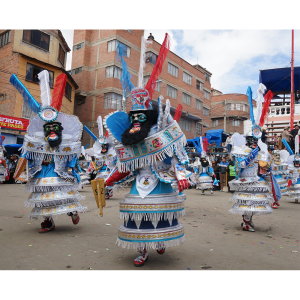
The Morenada is a dance in the Carnival of Oruro to honor the African slaves brought to Bolivia by the Spaniards.
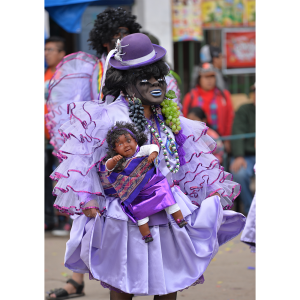
The negritas, also part of the Carnival of Oruro, are a reminder of the African ancestry of mixed-race Bolivians.
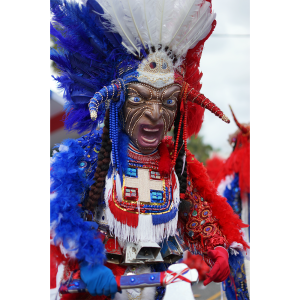
In the Dominican Carnival, Taíno ancestors are depicted with culturally inaccurate and stereotypical features. They are not meant to be disrespectful, but to celebrate the forbears.
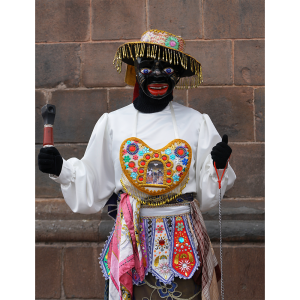
In Cusco, Peru, to wear the costume and mask of the Qhapaq Negro during Corpus Christi is a great honor, notwithstanding the stereotypical features.
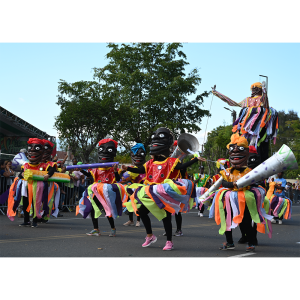
The Dominican people have a mixed heritage of Latino, African, and indigenous Taíno ancestry. The Tiznaos of the Dominican Carnival are not intended as a caricature, but as a reminder.